







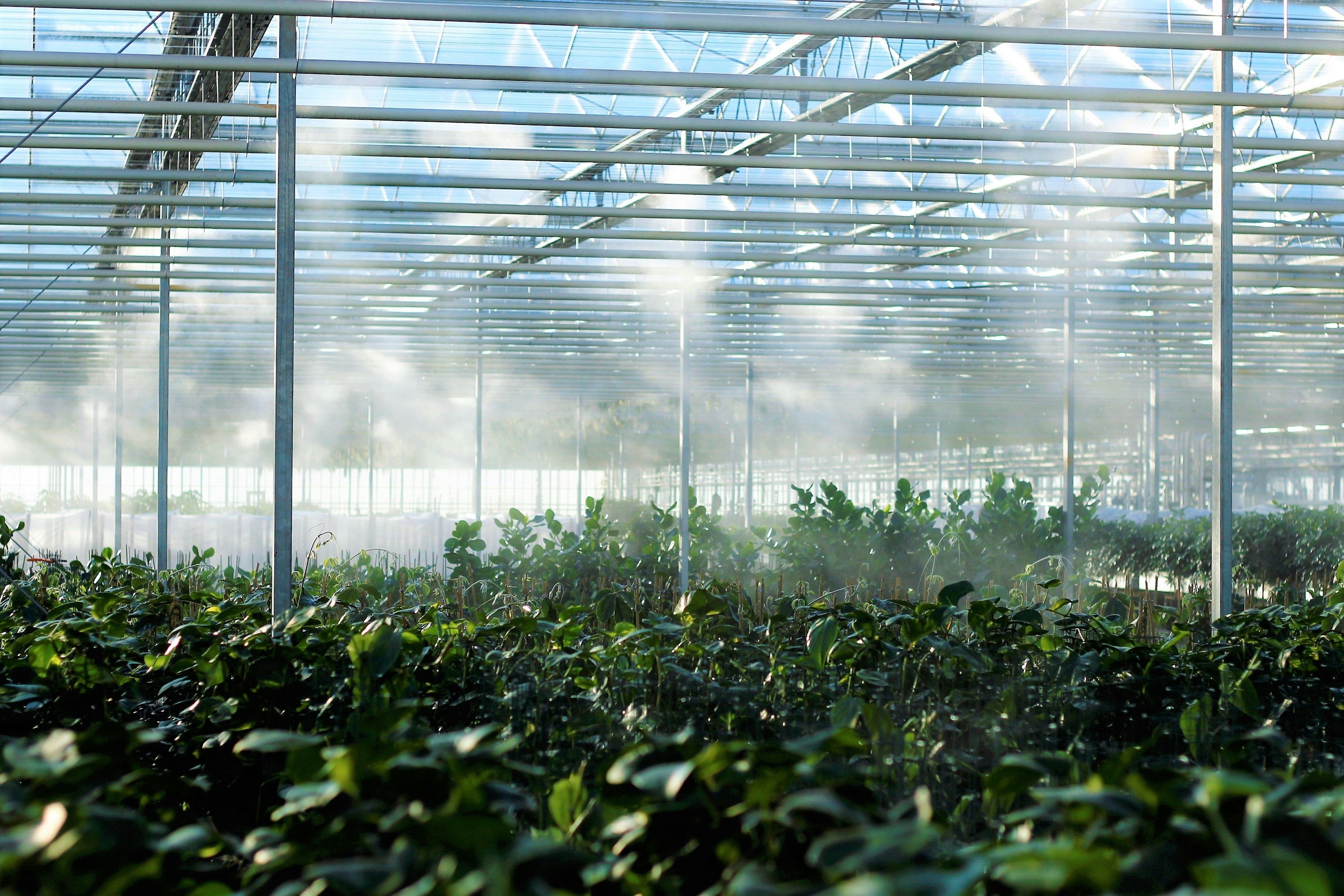
Volatile organic compounds (VOCs) are small, airborne metabolites that plants continuously emit as part of their normal physiology and defense mechanisms. Under stress, this chemical “breath” shifts in distinctive, highly informative ways, providing early warning signals of drought, heat, pests, or pathogens—often long before visible symptoms emerge.
Recent developments in sensing and artificial intelligence are making it possible to detect these patterns early and automatically, turning previously invisible stress signals into real-time insights
The chemical language of stress
Plants emit hundreds of VOCs, belonging to major groups like green leaf volatiles (GLVs), terpenoids, benzenoids/phenylpropanoids, and various aldehydes, alcohols, and esters. GLVs (such as C6 aldehydes) are released within seconds of physical damage, while terpenoids often reflect more specific or prolonged stresses. Aromatic compounds and fatty acid derivatives further enrich the chemical profile, adding information that helps differentiate stress responses. Recent reviews highlight how these compounds serve in defense, priming, communication and even thermal or oxidative protection.
Although a single molecule rarely tells the whole story, the composition, ratio, and timing of VOC emissions together create a highly informative signature.
How stress shapes VOC profiles
Biotic Stress
Herbivore feeding typically causes a rapid burst of GLVs followed by a rise in terpenoids and more complex sesquiterpenes known as herbivore-induced plant volatiles (HIPVs). These emissions can attract natural enemies of the herbivore or warn neighboring plants. Since chewing, sucking, or mining insects cause different types of damage, their VOC profiles often differ in recognizable ways. Chewing insects typically trigger strong, rapid emissions of green leaf volatiles and jasmonate-dependent terpenoids, whereas piercing-sucking insects elicit weaker GLV release and often favor salicylic acid–related compounds (e.g., methyl salicylate); leaf miners and other guilds produce still different profiles. These guild-specific VOC signatures are consistent and recognizable enough that plants, neighboring plants, and predatory/parasitic insects can distinguish the type of attacker.
Pathogen infections also reshape the VOC blend, often through strong involvement of the salicylic acid pathway, especially in biotrophs, which typically cause slower, sustained emission of methyl salicylate and certain benzenoids. Necrotrophs, however, primarily activate jasmonate/ethylene pathways, rapidly inducing terpenoids and GLVs much like chewing herbivores do. Viral infections tend to trigger delayed or systemic increases in a wide range of terpenes, benzenoids, and phenylpropanoids. Thus, although some overlap exists (particularly with piercing-sucking insects), the overall composition, dominant signaling pathway, and temporal dynamics of pathogen-induced VOCs remain distinctly recognizable.
Abiotic Stress
High temperatures, intense light, and oxidative stress dramatically boost emissions of isoprene and specific monoterpenes, which scavenge reactive oxygen species and stabilize membranes. Drought, even before visible symptoms emerge, reliably suppresses green leaf volatiles while strongly enhancing mono and sesquiterpene emissions often generating detectable early-warning signatures. Recent field and greenhouse studies in potato, sugar beet, maize, and other crops confirm that each abiotic stressor elicits distinct, reproducible VOC fingerprints.
Why specificity is subtle yet robust
Few individual VOCs are truly stress-specific; most (e.g., linalool, β-caryophyllene, MeSA, or (E)-β-ocimene) can appear under multiple biotic and abiotic conditions. True specificity emerges instead from the overall blend composition, quantitative ratios among compounds, and temporal emission dynamics (onset timing, diurnal patterns, and release kinetics). Receivers—whether neighboring plants, parasitic wasps, or predatory insects—integrate these multivariate cues into a reliable “fingerprint” that accurately discriminates herbivore identity, pathogen lifestyle, drought severity, heat stress, or combined stresses. Advanced chemometric and machine-learning analyses of full volatile profiles consistently confirm that this pattern-based coding, rather than the presence of any single marker compound, encodes the biologically meaningful information.
How VOCs Are Measured
Traditional VOC detection relies on headspace sampling coupled with gas chromatography–mass spectrometry (GC–MS), offering unparalleled chemical identification but requiring laboratory processing and hours-to-days turnaround. In contrast, emerging sensor technologies such as electronic noses, ion mobility spectrometers (HS-GC-IMS), portable GC systems, photonic noses (optical transduction with machine learning for >95% pattern classification), chemiresistive arrays (nanomaterial-based resistance shifts), electrochemical biosensors (enzyme-selective for markers like methyl salicylate), photoionization detectors (PID; UV-ionization for broad quantification), and surface-enhanced Raman scattering (SERS) nanosensors—now enable in-situ, near-real-time (seconds-to-minutes) monitoring. Wearable and multimodal variants further integrate VOC profiling with biophysical signals (e.g., humidity, temperature) for noninvasive, wireless field deployment in crops.
How AI Transforms Plant VOC Monitoring
Plant VOC blends are high-dimensional, multivariate datasets in which biological meaning is encoded in ratios, dynamics, and subtle co-occurrences rather than individual compounds. Artificial intelligence excels at decoding this complexity.
Pattern Recognition and Stress Classification
Machine-learning algorithms ranging from random forests and support vector machines to deep convolutional and transformer-based neural networks reliably classify stressor-specific VOC fingerprints. Trained on sensor-array outputs, portable GC–MS data, or full-spectral profiles, these models distinguish drought, heat, herbivory guilds (chewers vs. piercers), pathogen lifestyles (biotroph vs. necrotroph), and combined stresses with accuracies routinely exceeding 90–98% in both controlled and field settings.
Early and Pre-symptomatic Detection
Unsupervised (e.g., autoencoders, isolation forests) and semi-supervised anomaly-detection models identify deviations from healthy baseline profiles days to weeks before visible symptoms appear. This capability is particularly valuable for drought and latent pathogen infections, where labeled training data are limited yet early intervention is critical.
Multimodal Sensor Fusion and Robustness
By integrating VOC signals with hyperspectral imaging, leaf temperature, canopy reflectance, sap flow, soil moisture, and microclimate data, AI dramatically reduces false positives and improves specificity under fluctuating field conditions. Fusion frameworks often based on Bayesian networks, multimodal transformers, or graph neural networks are already deployed in commercial pilots for irrigation scheduling, early pest alerts in tomato and potato, and post-harvest spoilage prediction in fruit storage.
In short, AI converts raw chemical complexity into actionable, real-time agronomic insights that no human analyst or single-sensor threshold could achieve.
The Road Ahead
Plant VOCs are set to become routine diagnostic tools in crop monitoring, resistance breeding, and precision pest management. Expanding open-access databases, coupled with affordable photonic sensors, wearable chemiresistive arrays, and edge-capable AI, are rapidly turning laboratory concepts into field-ready systems.
Within the next few years, greenhouses and open fields will be able to continuously “sniff” the chemical language of stress, detect drought, pests, or pathogens days to weeks before visible symptoms appear, and trigger automated responses—precise irrigation, targeted biocontrol release, or early harvesting—protecting yield and quality with minimal chemical input.
This convergence of plant chemical ecology, sensor engineering, and artificial intelligence is shifting agriculture from reactive treatment to truly predictive, proactive management.
References
- Ameye et al., 2018 – Plant volatile-mediated signalling in necrotrophic–biotrophic interactions https://doi.org/10.1111/nph.14696
- Blokhina et al., 2024 – Early drought detection via VOC anomaly modelling in sugar beet https://doi.org/10.3389/fpls.2024.1357902
- Brilli et al., 2019 – Drought impacts on plant volatile emission https://doi.org/10.1016/j.tplants.2018.11.005
- Brilli et al., 2023 – Deep learning classification of maize VOCs under combined stresses https://doi.org/10.1093/jxb/erad278
- Choi et al., 2025 – SERS nanobionic sensors for real-time plant VOC monitoring https://doi.org/10.1038/s41565-024-01812-7
- Copolovici et al., 2014 – Drought-induced changes in BVOC emissions https://doi.org/10.1111/pce.12384
- Cui et al., 2023 – Semi-supervised anomaly detection of tomato VOCs https://doi.org/10.1016/j.compag.2023.108321
- De Moraes et al., 1998 – Herbivore-infested plants release distinct volatiles https://doi.org/10.1038/28515
- Erb et al., 2013 – Role of volatile emission in plant–insect interactions https://doi.org/10.1146/annurev-ento-011613-162132
- Gan et al., 2023 – Challenges and applications of volatile organic compounds monitoring technology in plant disease diagnosis https://doi.org/10.1016/j.bios.2023.115374
- Genet et al., 2025 – Transformer models for field-scale VOC fingerprinting https://doi.org/10.1093/insilicoplants/diad024
- Jansen et al., 2009 – Release of lipoxygenase products and monoterpenes by tomato plants as an indicator of Botrytis cinerea-induced stress https://doi.org/10.1111/j.1438-8677.2009.00223.x
- Jardine et al., 2017 – Isoprene and monoterpenes in oxidative stress protection https://doi.org/10.1111/nph.14430
- Jud et al., 2022 – VOC-based early warning of drought in crops https://doi.org/10.3389/fpls.2022.896047
- Li et al., 2024 – Multimodal AI for greenhouse VOC diagnostics https://doi.org/10.1016/j.bios.2024.116289
- Midzi et al., 2022 – Stress-Induced Volatile Emissions and Signalling in Inter-Plant Communication https://doi.org/10.3390/plants11162183
- Murali-Baskaran et al., 2022 – The Future of Plant Volatile Organic Compounds (pVOCs) Research: Advances and Applications for Sustainable Agriculture https://doi.org/10.1016/j.envexpbot.2022.105052
- Mithöfer & Boland, 2012 – Plant defense mediated by volatiles https://doi.org/10.1146/annurev-arplant-042110-103811
- Niinemets et al., 2013 – Drought effects on isoprenoid emissions https://doi.org/10.1029/2012JG002203
- PhytoFrontiers special issue on VOC sensing, 2025 https://phytofrontiers.org/special-collection-voc-2025
- Plant-Associated VOC Database (ongoing) https://voc-db.plant-ecology.org
- Possell & Loreto, 2022 – Isoprene and monoterpene roles in heat stress https://doi.org/10.1016/j.tplants.2022.02.006
- Quintana-Rodriguez et al., 2021 – Viral infection alters plant volatile profiles https://doi.org/10.3389/fpls.2021.652375
- Rowen & Kaplan, 2016 – Meta-analysis of herbivore guild VOC differences https://doi.org/10.1111/1365-2745.12561
- Sharkey et al., 2008 – Isoprene emission and thermotolerance https://doi.org/10.1016/B978-008045405-4.00055-5
- Turlings & Erb, 2018 – Tritrophic interactions mediated by herbivore-induced volatiles https://doi.org/10.1146/annurev-ento-020117-043230
- van Dam et al., 2024 – Commercial VOC-based early warning pilots in potato https://doi.org/10.1007/s11104-024-06582-4
- Vickers et al., 2009 – Isoprene and monoterpenes as antioxidants https://doi.org/10.1111/j.1365-3040.2009.02009.x
- Walsh et al., 2024 – Advancements in Imaging Sensors and AI for Plant Stress Detection: A Systematic Literature Review https://doi.org/10.34133/plantphenomics.0185