







Powdery mildew
Powdery mildew is a widespread group of obligate biotrophic fungal diseases affecting hundreds of plant species, including crops, ornamentals, and wild plants. The fungi grow primarily on plant surfaces and obtain nutrients through specialised structures called haustoria. They produce characteristic white, powdery colonies containing abundant conidia. Unlike many foliar pathogens, powdery mildews generally do not require free water for infection and often develop under warm conditions with high humidity but relatively dry leaf surfaces.
Affected crops:
Favorable:
20–27 °C · 60–95%
Season:
Spring through autumn (can occur year-round in greenhouse conditions with moderate humidity and limited direct sunlight)
Identification & symptoms
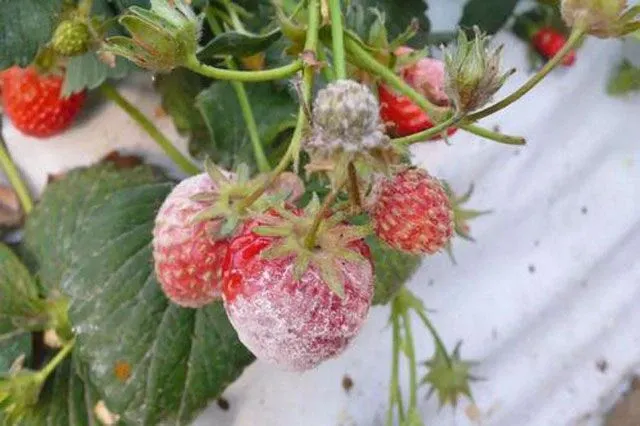
- White powdery growth: Characteristic white to gray, flour-like colonies develop on leaves, stems, petioles, shoots, flowers, or fruit.
- Leaf yellowing: Infected areas may become chlorotic or pale beneath or around colonies.
- Necrosis: Severe infections can cause brown, necrotic patches and premature leaf senescence.
- Leaf distortion: Leaves may curl, twist, become brittle, or develop abnormal growth.
- Reduced vigour: Severe disease reduces photosynthetic capacity and can suppress plant growth and yield.
- Flowers and fruit: Some species infect flowers and young fruit, causing distortion, russeting, cracking, or reduced fruit quality.
- Advanced infection: Colonies may become gray or brown as the fungus ages and produces sexual structures.
Life cycle
- Survival: Depending on species, powdery mildews survive as mycelium in living host tissue, dormant mycelium, or sexual structures called chasmothecia.
- Primary inoculum: In spring or under favourable conditions, chasmothecia release ascospores, while surviving mycelium can produce conidia.
- Dispersal: Conidia and ascospores are dispersed primarily by air currents.
- Germination: Spores germinate on susceptible plant surfaces under favourable temperature and humidity.
- Penetration: The germ tube forms an appressorium and penetrates an epidermal cell.
- Colonisation: The fungus develops superficial mycelium and specialised haustoria inside epidermal cells to obtain nutrients.
- Secondary infection: New conidia are produced on infected surfaces and dispersed to neighbouring tissues, allowing multiple secondary cycles during the growing season.
- Sexual reproduction: Some species form chasmothecia containing asci and ascospores, which can provide an important survival mechanism between seasons.
Favorable conditions
- Moderate to high humidity, particularly overnight and during periods of limited air movement.
- Warm to moderate temperatures, with many species developing well around 20–25°C.
- Dense, shaded canopies with poor air circulation that create humid microclimates.
- Dry leaf surfaces: Unlike many fungal diseases, powdery mildew generally does not require free water for infection, and prolonged leaf wetness can inhibit conidial germination in many species.
- Warm days and cooler nights can favour disease when they produce periods of high nighttime humidity without prolonged condensation.
Diagnosis
- Look for white to gray powdery fungal growth on leaf surfaces (top or bottom, depending on species)
- Check for yellowing or distortion of leaves surrounding powdery patches
- Rub affected area to confirm powder easily comes off on fingers (distinguishing from other diseases)
- Examine under magnification for characteristic conidia chains if confirmation is needed
- Note pattern of spread , often starts on older leaves or shaded/lower canopy areas
Prevention & treatment
Preventive management relies on improving air circulation and light penetration through proper spacing and pruning, combined with biological agents that colonize the leaf surface and suppress fungal establishment before symptoms appear.
Pros:
- Lower environmental impact than many conventional fungicide programmes.
- Can reduce reliance on synthetic fungicides.
- Generally lower resistance-selection risk than single-site fungicides.
- Some agents can induce plant defence responses.
- Some products are compatible with organic production where specifically approved.
Cons:
- Efficacy can be less consistent under severe disease pressure.
- Performance depends strongly on environmental conditions and application timing.
- Often requires preventive and repeated applications.
- Commercial availability and regulatory approval vary between crops and countries.
Fungicides: Common powdery-mildew control options include sulfur (FRAC M02), potassium bicarbonate, mineral or horticultural oils, and registered fungicides from FRAC groups such as 3, 7 and 11, depending on the pathogen and crop. Application: Apply preventively or at the first signs of infection, before colonies become extensive. Resistance management: Rotate or alternate fungicides with different modes of action, avoid repeated applications from the same FRAC group, and follow label restrictions. Because powdery mildew populations can develop fungicide resistance, chemical control should be integrated with cultural and biological measures.
Pros:
- Rapid and effective disease suppression when correctly selected and timed.
- Can protect new growth when applied before extensive colonisation.
- Multiple fungicide groups provide options for resistance management.
Cons:
- Fungicide resistance can reduce efficacy, particularly with repeated use of single-site products.
- Repeated applications increase cost and resistance-selection pressure.
- Some products can cause phytotoxicity, particularly under high temperatures or when oils are combined with incompatible products.
- Residue, environmental, worker-safety, and pre-harvest requirements must be considered.
- Registration and permitted uses vary by crop, pathogen, and country.
How we monitor it
Powdery mildew is primarily a humidity and canopy-microclimate problem rather than a leaf-wetness problem. Monitor RH, temperature, dew-point margins, and canopy humidity, while scouting regularly for the first powdery colonies. Identifying periods of sustained favourable humidity allows growers to improve ventilation, manage canopy density, and initiate biological or chemical protection before disease spreads.