


Whitefly
Whiteflies are small, sap-sucking insects that feed on plant phloem, causing direct feeding damage and excreting honeydew that promotes sooty mold growth. Beyond direct damage, whiteflies are notorious as vectors of numerous plant viruses (e.g., Tomato Yellow Leaf Curl Virus), making them one of the most economically damaging pests in vegetable and ornamental production worldwide. They thrive in warm climates and greenhouse environments, reproducing rapidly and developing resistance to insecticides easily.
Affected crops:
Favorable:
25–30 °C · Moderate
Season:
Spring to autumn
Identification & symptoms
- Leaf yellowing: Feeding causes chlorotic or yellow patches and general loss of vigour.
- Leaf weakening: Heavy infestations can cause premature leaf senescence, wilting, and leaf drop.
- Honeydew: Sticky honeydew accumulates on leaves and fruit.
- Sooty mould: Dark fungal growth develops on honeydew-coated surfaces, reducing photosynthesis and crop quality.
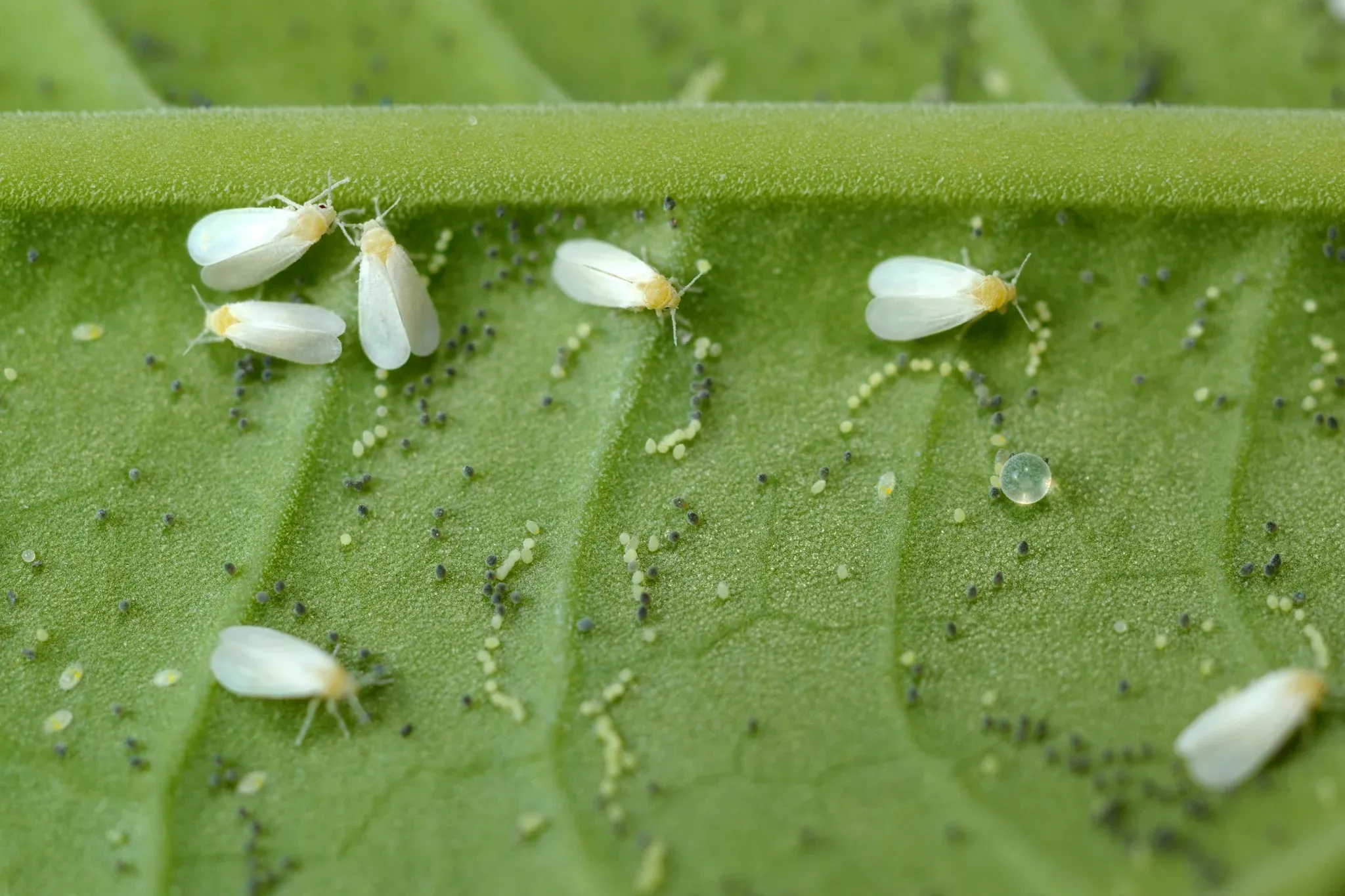
- Adult presence: Clouds of small white adults may fly from foliage when plants are disturbed.
- Immature stages: Scale-like nymphs and pupae occur mainly on the undersides of leaves.
- Virus symptoms: Vector species can transmit viruses causing mosaic, chlorosis, curling, stunting, deformation, or severe yield loss.
Life cycle
- Egg: Females lay small eggs, usually on the undersides of leaves.
- Crawler/first instar: The first nymphal stage is mobile and searches for a suitable feeding site.
- Nymphal stages: Later nymphs become largely sessile and feed continuously from phloem.
- Pupal/final nymphal stage: The immature insect develops into the winged adult.
- Adult: Adults emerge, mate, feed, and females begin laying eggs.
- Multiple generations: Under favourable conditions, whiteflies can complete multiple overlapping generations, allowing populations to increase rapidly.
- Virus acquisition/transmission: Virus transmission can occur when adults and/or nymphs acquire pathogens while feeding and subsequently transmit them to healthy plants; the efficiency and mode of transmission vary substantially among whitefly species and viruses.
Favorable conditions
- Warm temperatures strongly accelerate development and reproduction.
- Protected cultivation provides stable conditions and continuous host availability.
- Dense canopies provide abundant feeding and oviposition sites.
- Low natural-enemy activity can allow populations to increase rapidly.
- Continuous cropping and overlapping plantings can maintain populations between production cycles.
Diagnosis
- Inspect the undersides of leaves for adults, eggs, and scale-like nymphs.
- Gently disturb plants and look for the characteristic cloud of small white adults taking flight.
- Check leaves for sticky honeydew and subsequent black sooty mould.
- Look for yellowing, chlorosis, wilting, or reduced plant vigour under heavy feeding pressure.
- If virus symptoms are present, consider whitefly-mediated virus transmission rather than treating the insect damage alone as the cause.
- Use a hand lens to distinguish whitefly nymphs from aphids, thrips, scale insects, and other sap-feeding pests.
- For species-level identification, particularly within the Bemisia tabaci complex, use morphological and/or molecular diagnostics, because cryptic species cannot reliably be distinguished by field appearance alone.
Prevention & treatment
Biological control is a major component of integrated whitefly management, using parasitoids, predatory insects and mites, and entomopathogenic fungi to suppress immature and adult populations while reducing reliance on broad-spectrum insecticides.
Pros:
- Reduces reliance on synthetic insecticides.
- Can provide continuous suppression when natural enemies establish successfully.
- Generally lower environmental impact than broad-spectrum insecticides.
- Helps preserve beneficial arthropods and can fit well within IPM and protected-crop systems.
- Entomopathogenic fungi provide an additional biological control mechanism.
Cons:
- Effectiveness can be slower and more variable than chemical control.
- Performance depends on temperature, humidity, crop structure, and natural-enemy establishment.
- Broad-spectrum insecticides can disrupt parasitoids and predators.
- Biological control is generally most effective when populations are detected early and remain below damaging levels.
- Compatibility and commercial availability vary between crops and regions
- Parasitism rates drop below ~18 °C.
Insecticides: Whiteflies can be managed with insecticides from several IRAC groups, including acetamiprid and other neonicotinoids (IRAC 4A), spirotetramat (23), cyantraniliprole and other diamides (28), pyriproxyfen (7C), buprofezin (16), and insect growth regulators or feeding inhibitors, depending on species and crop registration. Timing: Target applications toward early nymphal stages and periods of increasing population before large numbers of adults and mature nymphs establish. Resistance management: Rotate insecticides according to IRAC mode-of-action groups, avoid consecutive applications of the same group, and integrate chemical treatments with biological control. Resistance is particularly important in Bemisia tabaci, where resistance to multiple insecticide classes has been extensively documented.
Pros:
- Rapid population reduction when the selected insecticide remains effective.
- Useful for preventing populations from reaching economically damaging levels.
- Multiple IRAC groups provide options for resistance-management programmes.
- Can complement biological control when carefully selected and timed.
Cons:
- Insecticide resistance is widespread, particularly in Bemisia tabaci.
- Repeated use of the same mode of action accelerates resistance selection.
- Broad-spectrum products can harm parasitoids, predators, and pollinators.
- Repeated applications increase production costs and environmental exposure.
- Product choice, residue limits, and pre-harvest intervals vary by crop and country.
How we monitor it
Sticky-trap counts plus climate steering toward drier, moving air slow build-up. Track trap trends alongside temperature and humidity to time introductions.